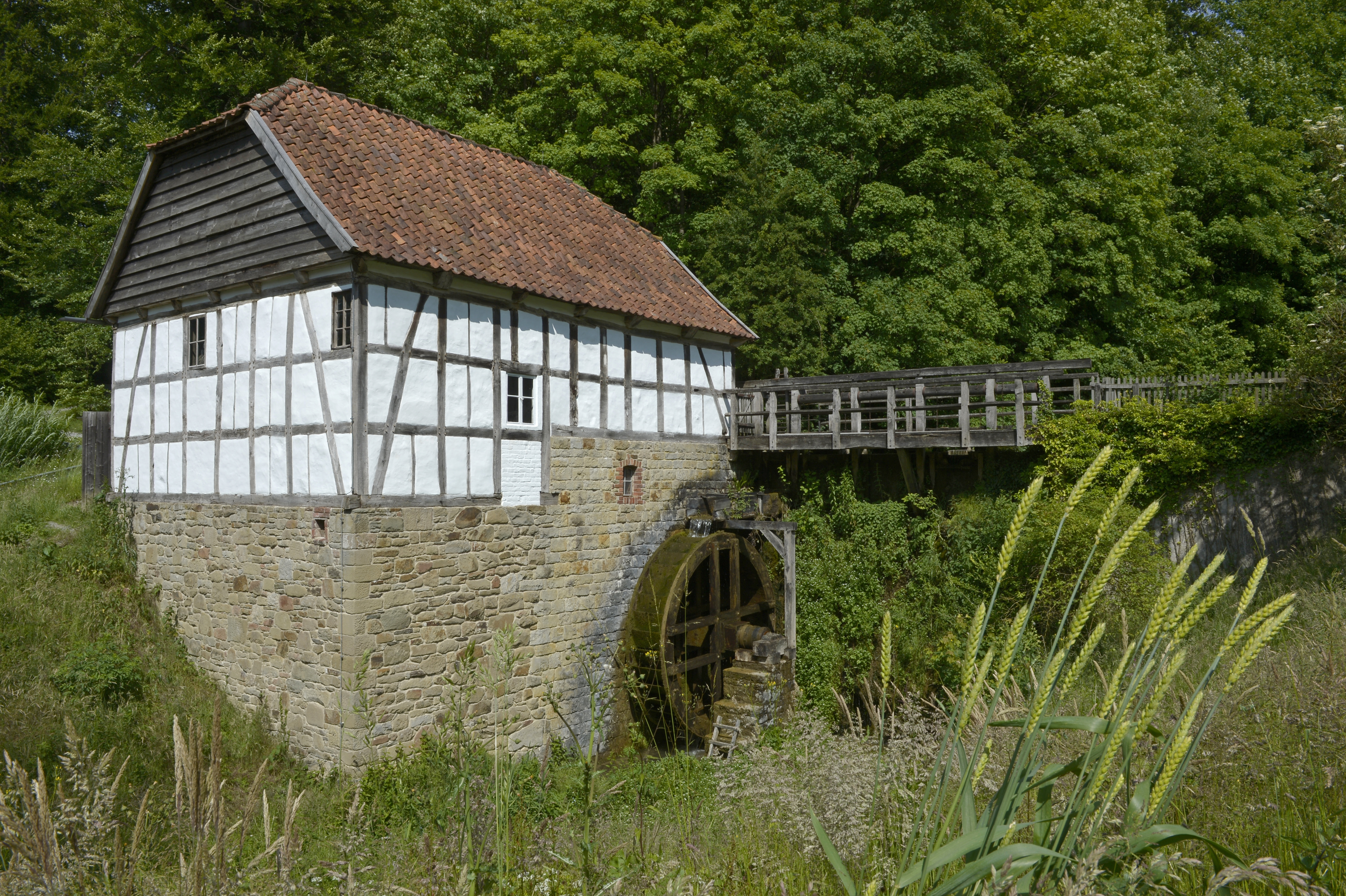
This mill was built in 1841 as a half-timbered structure on the Heller farm in Barkhausen (Melle, Osnabrück district). The grinding mill is located at the front, and the so-called boke mill (Bokemühle) with its own entrance is at the rear. Downstairs is a diesel engine, which has been used as an alternative to water power since around 1925. The watermill (dam height 5.5 meters, water drop height 4.2 meters) is driven by a so-called overshot wheel: the water flowing down from above drives the mill wheel. The mill is in constant operation for demonstration purposes. Inside, you can see a grinding mechanism for grain, a so-called boke mill with stampers for processing flax (Bokewerk), and a chopper.


This Post windmill comes from the Pape mill in Groß Lobke (municipality of Algermissen, Hildesheim district). Built in 1812 it came to the museum in 1981 and is shown in a condition about 1900. Post windmills (Bockwindmühlen) have been documented since around 1200. They are considered to be the first windmills in Central Europe. The entire mill stands on a wooden base – the post (Bock). A long beam (Steert, literally meaning tail) was used to turn the mill into the wind. Inside the mill, there was only room for a single set of millstones. Despite competition from more modern cap windmills since around 1600, post mills continued to be built until after 1800.



The Schaaf/Döpke mill in Tonnenheide (Rahden, Minden-Lübbecke district) was built in 1789. In cap windmills (Kappenwindmühlen) – also known as Dutch mills – only the cap with the sails is turned into the wind. In older post mills (Bockwindmühlen), the entire building was turned. The tower-like substructure of the cap windmill could be divided into multiple floors. This made it possible to have several grinding gears and to use the wind power in the most efficient way.



A capstan is a large rotating device that is moved by humans or animals. A horse capstan like the one in the museum converts the pulling power of horses into a rotating motion. Such capstans were once widespread and were used to drive threshing machines, choppers, or pumps, for example. The horses moving in a circle on the capstan track drive a long beam that sets a vertical shaft in rotation. This shaft is connected to a gearbox that converts the slow rotational movement of the animals into a higher rotational speed for the machinery.