
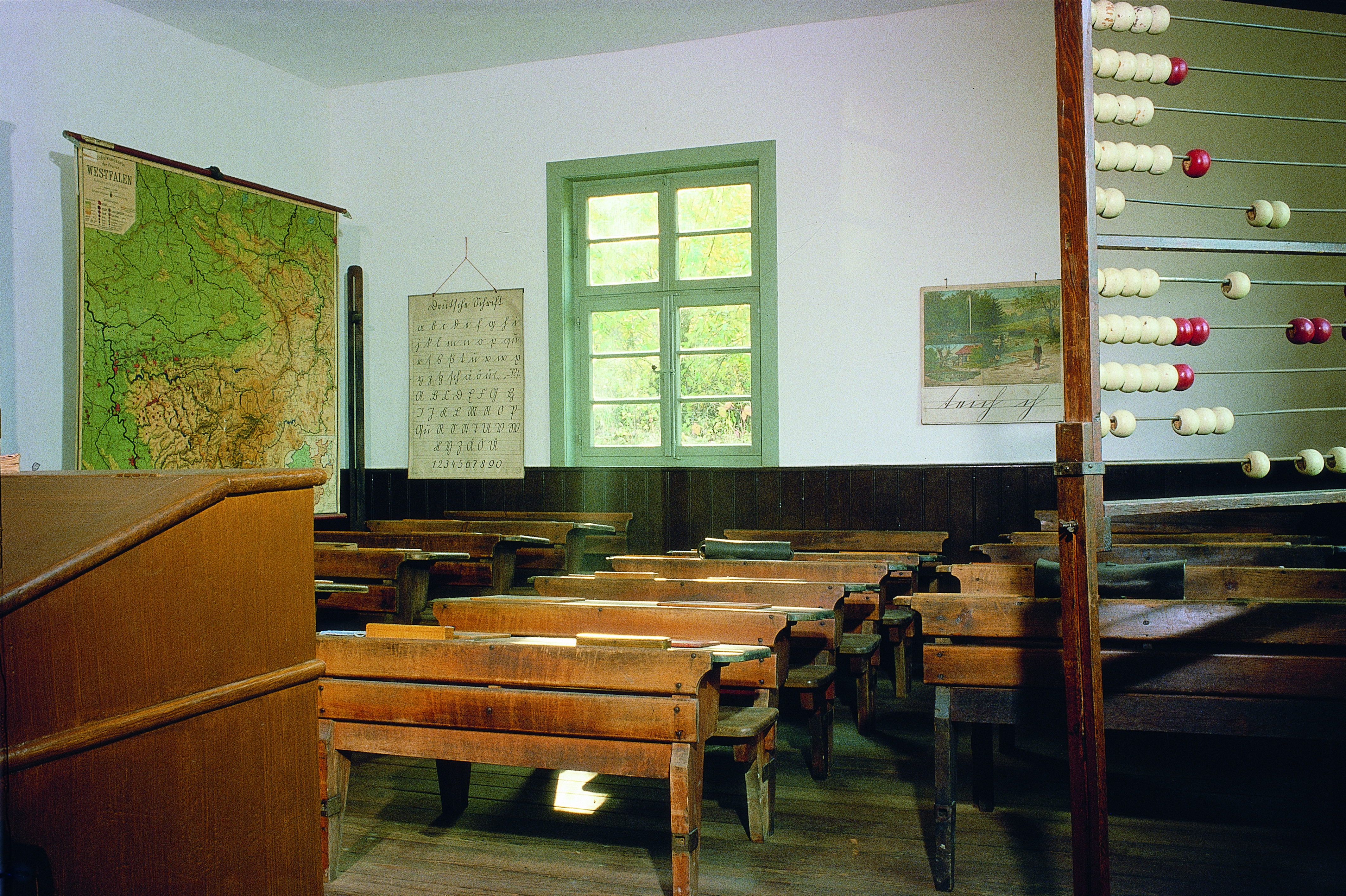
Since the 16th century, school education had been an important concern for the Protestant and Catholic churches. In church villages, there were so-called parish or sacristan schools in the churchyard, where the sacristan or cantor taught. In remote farming communities, separate farming schools were also established. Until the 1950s, these were mostly small schools (“Zwergschulen,” literally meaning “dwarf schools”) in which up to 40 children from several age groups were taught by one teacher. School lessons initially took place only in winter. In summer, the children had to herd cows in the morning or help with farm work.



The small school building was constructed in 1837 in the village of Thöningsen near the city of Soest (Soest district) according to a standard floor plan. It consists only of an entrance hall and one single classroom measuring a good 30 square meters. In such a “Zwergschule,” (literally meaning “dwarf school”) up to 40 children of various ages were taught by a single teacher. The boys and girls sat in pairs on wooden benches and wrote on slate boards. Blackboard, maps, wall charts, globes, and slide rules were among the teaching materials used.


The half-timbered chapel used to stand in Werthenbach (Netphen, Siegen-Wittgenstein district), where it belonged to the Catholic parish church in the neighboring village. Built in 1737, the chapel was used for occasional devotions. The sturdy half-timbered construction is characteristic of the Siegerland region and neighboring Hessen. School lessons were also held in the chapel, and in 1816 a separate classroom was added. Here, up to 40 children of different ages could be taught by one teacher. In the 1950s, a new school building was constructed.